Clements Hall
Book cover quality image from LC

Clements Hall Local History Group

Exploring the Scarcroft, Clementhorpe, South Bank and Bishophill areas of York

Clements Hall Local History Group

Exploring the Scarcroft, Clementhorpe, South Bank and Bishophill areas of York

View navigation

The Tramways of Blossom Street

We're very much looking forward to the launch of our new book, about Blossom Street, later in October. As a taster, researcher Keith Watson writes about a well-used form of historic transport along the street.
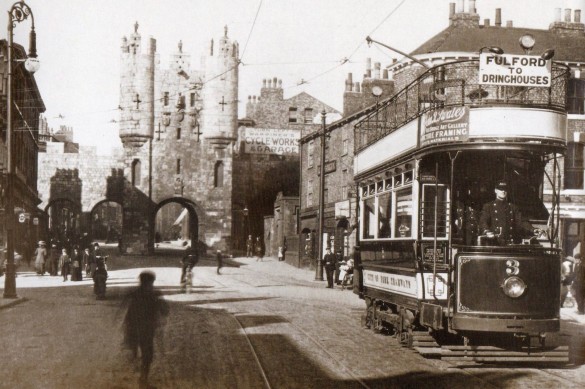
Tram near Bar Peter Stanhope 300

Dringhouses tram heading down Blossom Street c1912

An idea for a tramway system in York was given Council consent on 11 November 1878 and was approved by the Act of Parliament in 1879 for the York Tramways Company. The construction of the 4ft gauge tramway started in July 1880, with an initial proposed route from York Castle Mills Bridge to Fulford. The line was completed in October 1880, and opened in April 1881. The Board of Trade originally approved the use of steam power but that proved unsuccessful and horse-drawn power was finally used.

Eventually, three routes were opened, including from Fulford to Castle Mills Bridge, Nessgate, Micklegate, Blossom Street and the Mount. The original proposal for a terminus at Knavesmire Gates was never actually built and the horse tramway terminated at the junction with Dalton Terrace, opening in 1882.

The horse-drawn tramway system was acquired by a new company, the City of York Tramways Company, in 1886, a subsidiary of the Imperial Tramways Company. The City of York Tramways Company itself was due to be taken over on 19 January 1909 by the York Corporation Tramways, but this was delayed until 27 February 1909.

On 30 April 1909, a poll of Electors voted in favour of replacing the deteriorating horse-drawn tram system with a new electric overhead tramway system, with a narrower 3ft 6in gauge than the horse tramways.  The last horse tram service ran on 7 September 1909 and was replaced by a temporary horse bus service until 8 January 1910.

Among four proposed electric tramways routes, one was from Nessgate to Dringhouses and another from Railway Station to Acomb. These routes were approved by a Light Railway Order on 19 October 1908.

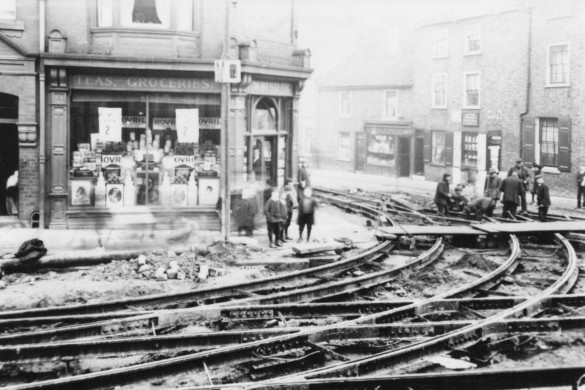
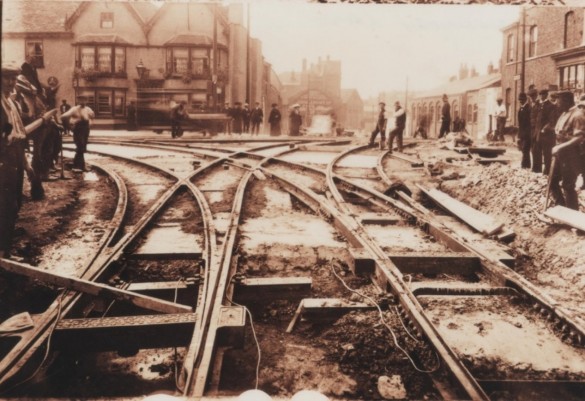
Work commenced on the electric tramways from 1 September 1909, and the first route from Fulford to York started on 20 January 1910. Further routes were constructed, including from the Railway Station and onwards through Blossom Street, with a branch off down Holgate Road to Holgate Railway Bridge and Acomb, the other continuing along the Mount and Tadcaster Road, eventually terminating at the junction with Ainsty Avenue, Dringhouses (this was later renamed Ainsty Grove). These two routes covered 3.71 miles, which included double track from the railway station, along Blossom Street, the Mount and Mount Vale, reducing to single track from Knavesmire Gates to Ainsty Avenue. There were also triangular junctions at Queen Street/Nunnery Lane and Blossom Street/Holgate Road junctions, allowing a greater flexibility of tram routes.

On 17 March 1910, the Board of Trade inspection took place and service for both these routes and to Dringhouses commenced immediately the next day, with the section to Holgate Bridge commencing slightly later on 29 March 1910. The Holgate Bridge over the railway was not wide enough nor strong enough for the new trams and an agreement was made for the construction of a new bridge by the North Eastern Railway Company, with a contribution from the Council of £3,500.  Meanwhile, from 9 June 1910, trams serving Acomb ran on an isolated section from Holgate Bridge, where passengers had to disembark to cross the bridge on foot. As the new Holgate Bridge was completed by June 1911, through trams commenced from the city to the new terminus at Acomb from 1 August 1911.
 

Picture1

Construction of tramlines at Blossom Street and Holgate Road Junction 1910
Picture2

Construction of the tram line at the junction of Nunnery Lane and Blossom Street 1913

The initial 18 tramcars were built by the Brush Company, and each was 28 feet long, four-wheeled, 8ft 6in wheel-based, with open tops, canopied platforms and half-turn staircases. They held 48 passengers, 22 on long wooden benches downstairs and the remainder using transverse seats on the upper deck, which was illuminated from two large lamps at the head of each stairway. Folding metal destination boards were fixed to the upper deck railings at each end. The livery was royal blue and cream with lining and lettering in gold: 'City of York Tramways'.

As the network increased, by 1918 there were no less than 23 departures per hour from each side of the city, giving 700 arrivals at the railway station, equating to one per minute. There were in total 36 trams, with a maximum combined capacity of 1,944 people. A 'Transfer Ticket' became available, where passengers could change trams from one route to another. Two such places were at Queen Street corner and the Railway Station.

Picture3

Dringhouses bound tram heading down Blossom Street from Queen Street corner c1911

In 1926, most of the single track on the Dringhouses route was re-laid and in 1929, the Council’s Streets and Buildings Department ceased to be responsible for track renewals, except for the paving. The Tramways Committee appointed a Permanent Way Inspector with a maintenance crew.

As early as 1931, the London & North Eastern Railway Company suggested that the electric trams be scrapped in favour of motor bus services, operated by one of their subsidiary bus companies. By 1932, many York Councillors were also in favour of scrapping the trams, as they were now being considered outdated. The infrastructure was worn out by then and Ministry of Transport regulations meant that the tramcars could not be updated.

In 1932, the Corporation was approached by the West Yorkshire Road Car Company, with suggestions for co-ordination of services within the city. From April 1934, a Special Transport Committee was formed, with all the York Corporation’s tramway network becoming part of a joint committee arrangement to co-ordinate and operate services.

In July 1934, it was agreed that the ageing tramcars would have to be replaced by motor buses and it was decided to start abandoning the tram routes, to be replaced by motor buses. The City to Dringhouses route along Blossom Street was the first tram route to be abandoned, on 6th January 1935. Elsewhere, the remaining routes lasted until final closure on Saturday, 16 November 1935. From the following day, all routes were replaced with motor buses of the York-West Yorkshire Joint Committee.


Sources

A History of the City of York by C. B. Knight (1944 Privately Published)

Tramways of York by M. J. O’Connor & G. J. Mellor (Tramway Review Magazine issues 18 (1955) & 19 (1956))

The Horse Tramways of York 1880-1909 by Hugh Murray (1980 Light Rail Transit Association)

York Buses by Keith Jenkinson (1984 Auto Bus Review Publications)

City of York: Tramway, Trackless and Motor Bus Operations up to 1935 by West Yorkshire Road Car Co. Information Service (West Yorkshire Road Car Co. Information Service 1977)

City of York Tramways by Joe Murphy (2002 Privately Published)

The Tramways of West Yorkshire by J.C. Gillham & R.J.S Wiseman (2001 Light Rail Transit Association)

York Tramways and Trolleybuses by Barry Marsden (Middleton Press 2006)